Amino acid (AA) containing dialysis solutions for peritoneal dialysis (PD), often referred to in the US as intraperitoneal nutrition (IPN),
was first conceptualized in the 1960’s. In the early 2000’s, a 1.1% AA containing dialysis solution was created for commercial use and during that time
several research studies were conducted.
People using PD are at high risk of inadequate protein availability and malnutrition due to several factors including reduced appetite,
protein loss during dialysis, and GI issues dissuading them from adequate oral intake. In fact, as many as 50% of PD patients experience malnutrition.
The early research on IPN identified the following potential benefits for malnourished PD patients:
- Up to 80% of the AA in IPN are absorbed
- The longer the dwell, the more protein absorption
- IPN helps improve albumin levels
- With improved albumin levels, some patients see less edema or fluid retention
- The AA in IPN are taken up by muscles indicating immediate use for protein synthesis
Despite early research, many clinicians would like more up to date evidence of the value of IPN. Read on as we outline recent publications on IPN.
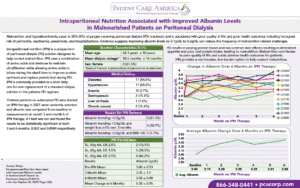
Intraperitoneal Nutrition Associated with Improved Albumin Levels in Malnourished Patients on Peritoneal Dialysis
Presented at ASN Kidney Week 2024
- Thirteen patients on automated PD starting IPN therapy in 2021 were randomly selected
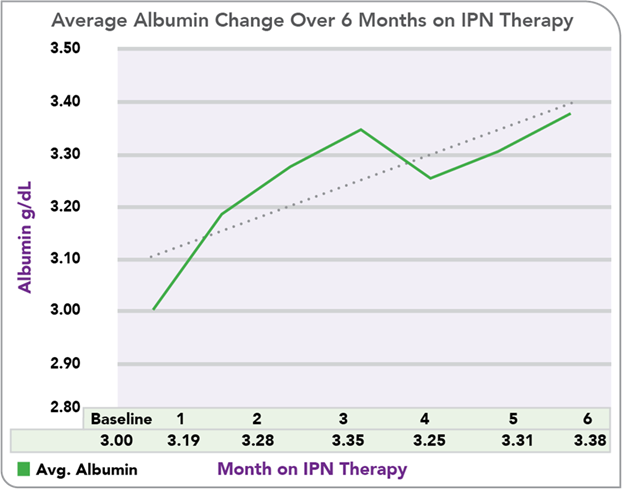
- Albumin was compared from baseline to measurements at month 3 and month 6 of IPN therapy. Patients served as their own controls.
- Change from baseline to months 3 and 6 were analyzed using a t-test and found the change in albumin was statistically significant, p value 0.002 at 3mos and p value <0.001 at 6mos.
Published in International Urology and Nephrology, Deng et al 2025
- 6-month prospective study of malnourished PD patients who served as their own controls.
- 142 PD patients completed study
- Prescribed overnight dwell of 1.1% AA-containing dialysis solution
- Significant improvements observed in albumin, prealbumin, nPCR, SGA scores, and handgrip strength
- Improvement in albumin was independent of oral protein intake
- Patients experienced improvement in symptoms including fatigue, anorexia, and nausea when using the AA-PD treatment
- No serious adverse events were attributed to the AA-PD treatment
Both these studies show benefits to the patients. At the same time, longer duration studies on additional outcomes are warranted. If you would like to learn more about Patient Care America’s contributions to research as well as our IPN and IDPN therapies, please visit us at pcacorp.com or connect with us
on social media.
References
- Falcão, H., & Japiassu, A. M. (2011). Albumin in critically ill patients: controversies and recommendations.
Rev Bras Ter Intensiva, 23(1), 87-95. - Park, M. S., Choi, S. R., Song, Y. S., Yoon, S. Y., Lee, S. Y., & Han, D. S. (2006). New insight of amino acid-based dialysis solutions. Kidney International, 70, S110-S114.
- Asola, M., Virtanen, K., Någren, K., Helin, S., Taittonen, M., Kastarinen, H., … & Nuutila, P. (2008). Amino-acid-based peritoneal dialysis solution improves amino-acid transport into skeletal muscle. Kidney International, 73, S131-S136.
- Hanna, R. M., Ghobry, L., Wassef, O., Rhee, C. M., & Kalantar-Zadeh, K. (2020). A practical approach to nutrition, protein-energy wasting, sarcopenia, and cachexia in patients with chronic kidney disease. Blood Purification, 49(1-2), 202-211.
- Zha, Y., & Qian, Q. (2017). Protein nutrition and malnutrition in CKD and ESRD. Nutrients, 9(3), 208.
- Mehrotra, R. (2013). Nutritional issues in peritoneal dialysis patients: how do they differ from that of patients undergoing hemodialysis?.
Journal of Renal Nutrition, 23(3), 237-240. - Slusser, Maiya. Intraperitoneal Nutrition Associated with Improved Albumin Levels in Malnourished Patients on Peritoneal Dialysis: PUB413.
Journal of the American Society of Nephrology 35(10S):10.1681/ASN.20249phfcjwq, October 2024. | DOI: 10.1681/ASN.20249phfcjwq - Deng, S., Xuan, H., Chen, L., Su, X., Su, Y., Lu, Y., … & Shi, W. (2025). Overnight-dwelled amino acid-based peritoneal dialysis solutions for malnutrition in CAPD: a prospective real-world study. International Urology and Nephrology, 1-11.
We thank our guest blogger Maiya Slusser, MS, RDN, CD, CNSC, Director, Research and Education for sharing her knowledge and writing this blog post!